
One of the easiest mistakes to make when learning watch repair is believing that every problem needs to be solved immediately. Sometimes the correct repair decision is to stop.
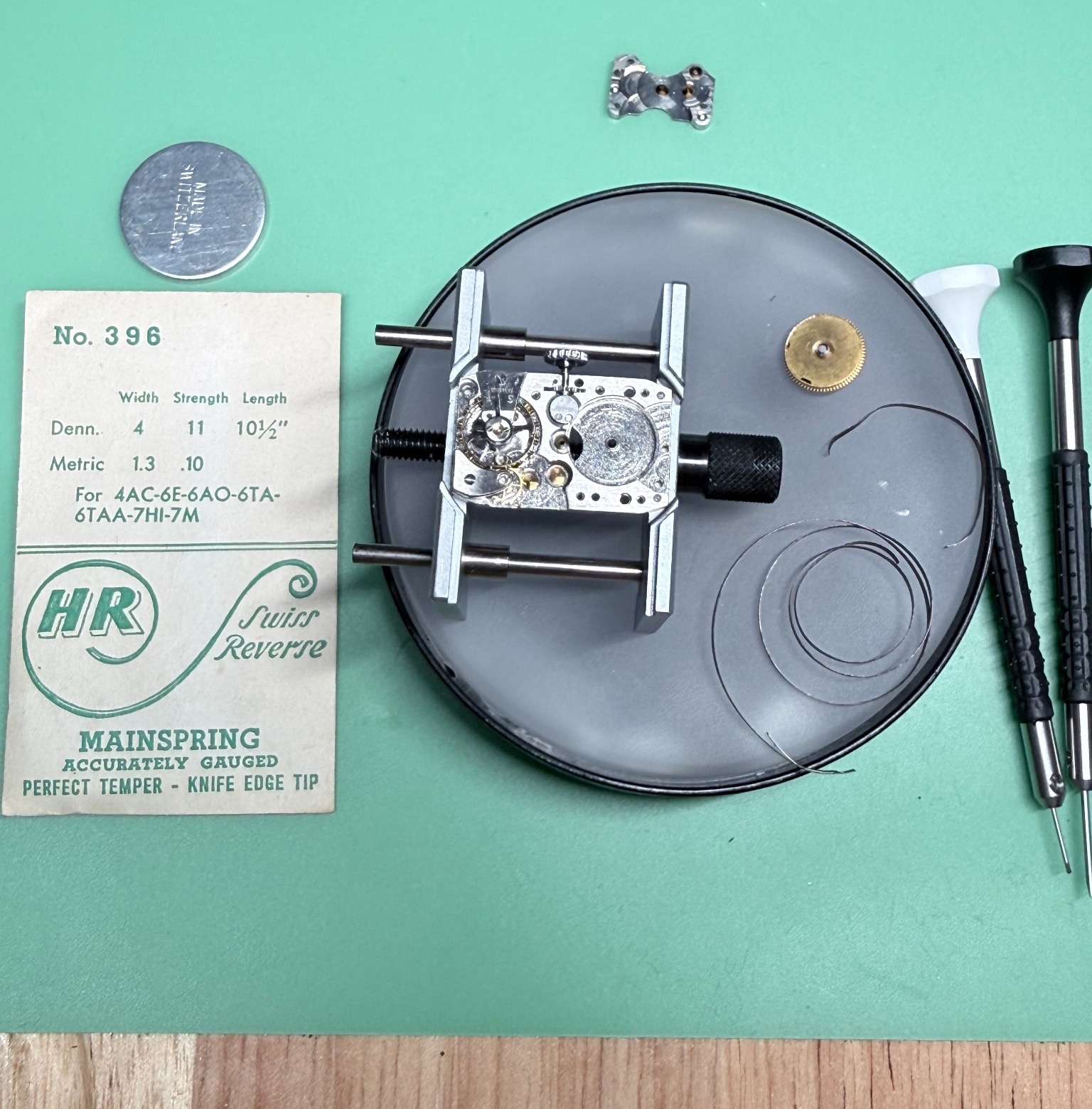
I recently began servicing a 1920s rectangular Elgin movement. The movement itself was remarkably clean for its age. After disassembly and cleaning, most of the components looked very good. The problem appeared when I reached the mainspring.
It was broken.
Fortunately, I have a selection of replacement mainsprings, and I was able to find one close to the dimensions of the original. At first, this looked like a straightforward repair. It was not.
The mainspring problem
A mechanical watch stores its energy inside the mainspring barrel. As the watch is wound, the mainspring coils tightly around the barrel arbor. That stored energy is gradually released through the gear train and ultimately regulates the motion of the watch.
Because the spring must fit inside a relatively small barrel, installing one by hand can be deceptively difficult.
The original Elgin mainspring measured approximately 1.25 mm wide and 0.09 mm thick.
The H&R replacement pictured above is marked 1.30 mm wide and 0.10 mm thick. That difference sounds insignificant, but with mainsprings, small changes in thickness can substantially affect the strength and behavior of the spring.
I tried that replacement, but without the proper system to control the installation, it ultimately broke. I also located a closer candidate measuring approximately 1.30 mm by 0.09 mm. The dimensions are closer, but the installation method still matters.
Why a mainspring winder matters
Historically, watchmakers have installed mainsprings using specialized tools called mainspring winders. A mainspring winder compresses the spring evenly into a drum. The compressed spring can then be transferred into the mainspring barrel without forcing or distorting it.
It accomplishes three things that are difficult to achieve consistently by hand:
- It keeps the coils flat and controlled.
- It reduces the risk of bending or breaking the spring.
- It prevents unnecessary stress on the barrel wall and arbor.
That was the point where I stopped.
Experience is also learning when not to improvise
Watchmaking encourages improvisation. Vintage watches routinely present problems that do not have convenient modern solutions. Parts may be obsolete. Specifications may be difficult to locate. Previous repairs may have altered the watch decades before it reaches the bench.
Some improvisation is unavoidable. But there is an important distinction between improvising because a solution must be created and improvising simply because the correct tool is not available. The second can become expensive very quickly.
A replacement mainspring is relatively inexpensive. An original barrel, arbor, bridge, pivot, or vintage movement component may not be. The goal is not simply to make the watch run. The goal is to preserve as much of the watch as possible while returning it to reliable mechanical condition.
The Elgin will wait
For now, this restoration is going back into the project tray. I plan to acquire a proper Bergeon mainspring winding system before continuing. It is an investment, but it is also the correct tool for work I expect to perform repeatedly at the Balance of Time bench.
Once the winder arrives, I will return to the Elgin, install a properly sized mainspring, complete the movement assembly, lubricate it, regulate it, and see what nearly a century of mechanical engineering still has left to give.
There is something satisfying about bringing an old watch back to life. But there is also something satisfying about knowing when to leave it alone. Sometimes progress in watchmaking means putting the screwdriver down and waiting until you can do the job properly.