
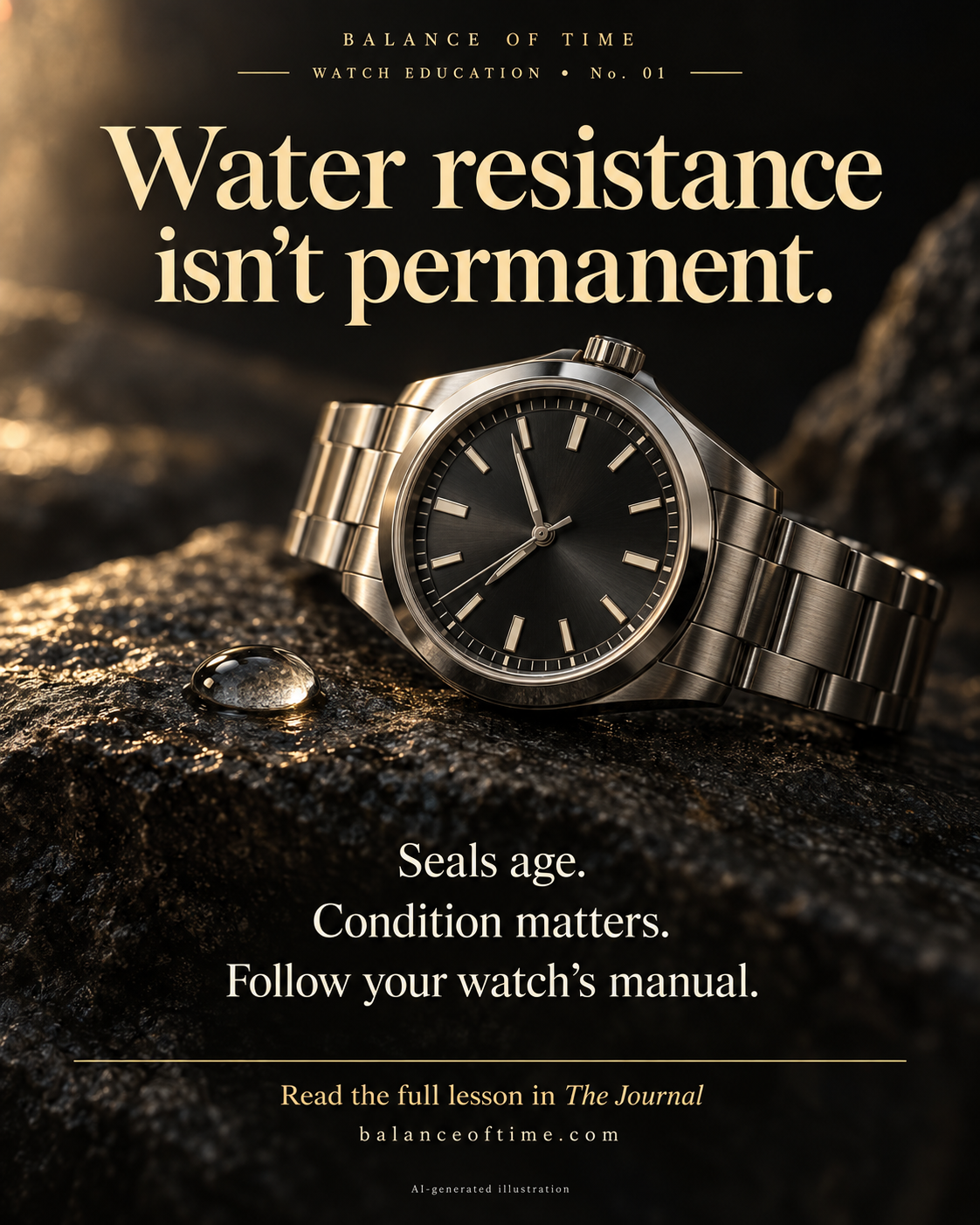
The number on a watch’s case back tells only part of the story. Before taking a watch into water, consider its model instructions, present condition and service history.
Welcome to our weekly education series for watch owners and curious watchmakers. Our first lesson is a distinction worth remembering: a marked rating and the condition of an individual watch are different questions.
Why yesterday’s protection may change
Seiko explains that water resistance is not a permanent guarantee. Gaskets age, and an accidental impact can deform parts and affect protection. Its guidance also emphasizes using the correct conditions for the watch’s rating and keeping the crown in the proper position. Read Seiko’s water-resistance guidance.
That matters especially when the history is unknown. An old engraving does not tell you when seals were last checked or whether the case has since suffered damage. Our conservative recommendation for an unassessed vintage watch is to keep it dry until its suitability for water exposure has been evaluated.
Read the manual, not just the number
Citizen distinguishes ordinary water-resistant watches from watches designed for diving. Its chart separates everyday splashes, swimming and diving applications; do not treat every depth marking as permission for every activity. Check the instructions for your exact model rather than transferring advice from another watch. See Citizen’s rating and care guide.
Three habits that help
- Leave the controls alone when wet. Citizen advises against operating crowns or buttons underwater or while wet, and against using a screw-lock crown unlocked.
- Keep heat out of the routine. Citizen cautions against hot-water immersion, hot springs and saunas.
- Take suspected water entry seriously. Citizen says to stop using the watch and request repair if water may have entered; internal parts, electronics and the dial can be damaged.
A useful conversation at the bench
For an owner, the next step is a clear inquiry. For a watchmaker, it is a chance to explain what has actually been checked. Here are questions to bring to that conversation:
- What is the exact model, and which activities does its manufacturer allow?
- Is the service history known, and has there been an impact or recent case opening?
- Has this watch been assessed or tested for the intended use? What result was recorded?
- Are there condition or parts limitations that change the advice?
Keep the conclusion specific. “The case back says 100 m” is an observation. “This watch is suitable for the activity I have planned” needs more information. Ask what supports that conclusion.
This lesson explains how to frame the discussion; it is not a model-specific test procedure or a statement that a particular watch has passed a test.
Your next step
Write down the model, what you want to use it for and any known service history. Owners in Vail and greater Tucson can contact Balance of Time to discuss a watch’s condition and the appropriate next step.
Sources & further reading
Manufacturer guidance reviewed September 16, 2026. Follow the instructions for your specific watch.