
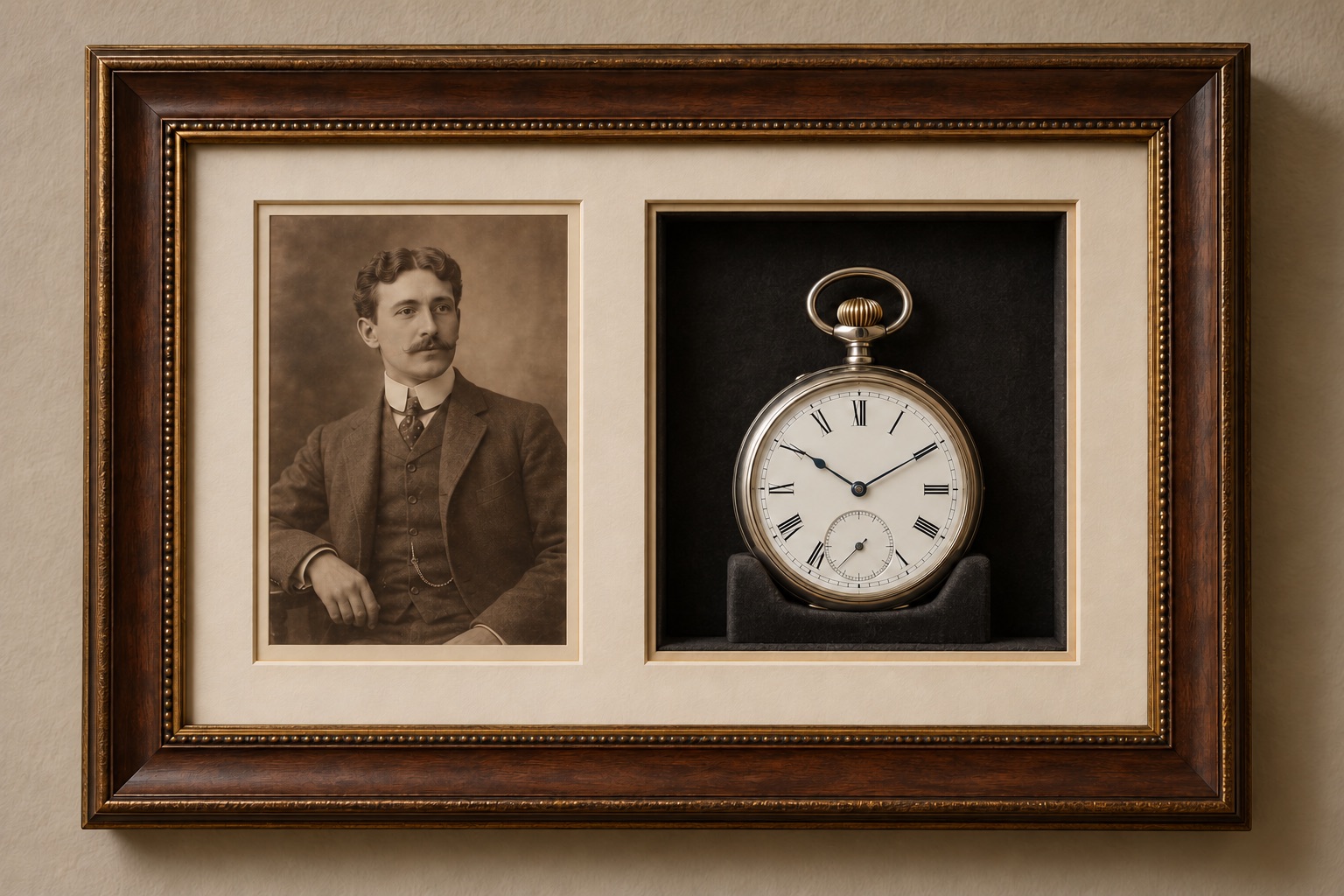
A family pocket watch is easier to understand when the person who carried it is visible too. A photograph can show where a chain sat across a waistcoat. A short note can explain who owned the watch and how it came into your hands. These details give the next person something more useful than a beautiful object and a guess.
Displaying an heirloom does not need to mean building a small museum in the sitting room. A thoughtful arrangement can make the watch part of everyday life while keeping its history close and its physical needs in mind.
Start with what you know
Before buying a frame, write down the owner's name, the relationship to the family and any dates you can confirm. Add how the watch passed from one person to another. Record who supplied each memory, and when. A voice recording of someone telling the story can preserve details that a neat label leaves out.
Leave room for uncertainty. A family photograph showing a watch chain does not by itself prove that the watch in your hand is the same one. If the connection rests on family recollection, say so. "Believed to have belonged to" is a perfectly respectable beginning. There is no need to promote a possibility into a fact just because the frame has arrived.
Keep the full account separately, with photographs of the watch and any inscriptions you can see without forcing anything open. The display label can then be brief. A name, a date if known, and one particular detail about the person are usually enough to invite a conversation.
A shadowbox with a family photograph
If you have a photograph of an ancestor wearing the watch, a shadowbox is an appealing way to bring the two together. Place a high quality copy of the photograph beside the watch, rather than directly behind it, so neither has to compete for attention. Store the original photograph safely. For a copy or original mounted in a frame, use suitable photographic materials and leave space between the image and the glazing. [1]
The mount matters more than the arrangement. A removable, padded cradle should support the watch's body without squeezing it. Give the chain and fob their own support instead of hanging the whole watch from its antique bow or chain. Nothing should be glued to the watch. These are applications of museum mounting principles, not a specification for a homemade conservation case. [2]
Ask a conservator or framer experienced with historic objects about the complete assembly. A deep frame, an attractive lining and the word "archival" on a packet do not establish that every material inside is suitable.
Other ways to make room for it
A small glazed tabletop case suits a watch you want to see from more than one angle. Use a stable body support, with the photograph and story card alongside. Choose a quiet shelf away from the edge. A glass dome is a display shape, not a guarantee of preservation; the base, mount and enclosed materials still need consideration.
A shallow cabinet drawer offers a more private arrangement. Give each watch its own fitted space so it cannot knock against another, and place a short identification card nearby. [3] A photograph above the cabinet can keep the owner present even when the drawer is closed. This can also suit a family that enjoys taking the watch out occasionally rather than leaving it permanently on view.
A family timeline works when there are several watches or well documented owners. Keep it simple, with a separate position for each object and a clear account of its connection. Do not arrange unrelated pieces into a story of inheritance unless the evidence supports it. A timeline can include an honest gap.
A photographic display is another good option. An enlarged image of the dial or an inscription can sit beside the owner's portrait while the watch remains stored safely. This is particularly useful when a watch is fragile, the room is unsuitable, or the original belongs to a relative elsewhere. Label the images clearly so a viewer knows what they are looking at.
Choose the place and materials carefully
Choose a dry, secure location with reasonably steady temperature and little vibration. Avoid a sunny windowsill, a radiator shelf or a damp room. A cover can help with dust, but does not make an unsuitable location suitable. [4] Photographs and documents are vulnerable to light, including ordinary visible light. Glazing that filters ultraviolet light helps, but does not make permanent exposure harmless. Copies are often the simplest answer for a long term display. [1]
Be particular about the materials nearest the watch. Unspecified craft felt, foam and adhesives are not automatically safe. Some materials release substances that can damage metals, and some foams deteriorate with age. Ask for identified materials appropriate to the object, rather than choosing a lining by softness alone. [5] Bare wood and MDF also need careful consideration inside an enclosure; a coat of varnish is not a reliable cure for their emissions. [3]
Resist polishing the case simply to prepare it for display. Polishing removes metal, and plated or gilded surfaces are particularly vulnerable. [6] If the watch's condition or service history is unknown, ask a watchmaker experienced with antique pocket watches to assess it before winding or running it. Displaying a watch does not require it to be running. [4]
If it has an older luminous dial of unknown composition, do not open the watch or disturb the dial. Some contain radium, even when they no longer glow. Seek specialist advice. [7]
Keep the record with the watch
Make the display easy to open for careful removal and inspection. Keep a copy of the history, photographs and any service paperwork in a clearly named folder, with another copy somewhere separate. Note where the original family photograph is stored. A digital link can be useful, but include a readable name and short account as well.
The most useful detail may be a small one: where the owner worked, when they wore the watch, or the words a relative used when passing it on. Write that down now, with its source. The next person should not have to start the story again.
Sources
- National Archives and Records Administration: Displaying Your Family Treasures. Supports displaying copies, storing originals, light precautions, suitable photographic mounting materials and separation from glazing.
- National Park Service: Exhibit Planning Design and Fabrication Specifications, pages 119 to 120. Supports removable, padded mounts and avoiding stress or attachment damage. The watch body cradle and independent chain support are practical applications of these general principles, not watch specific case instructions.
- Canadian Conservation Institute: Caring for metal objects. Supports avoiding contact between objects, damp conditions and harmful display materials. Discusses wood emissions and the limits of paint and varnish as barriers.
- Canadian Conservation Institute: Basic Care of Clocks and Watches. Supports dry, stable, secure conditions, dust and vibration precautions, and specialist care for delicate mechanisms. It is not used here as a source of instructions to oil or clean a watch.
- Canadian Conservation Institute: Products Used in Preventive Conservation. Supports selecting identified, compatible display materials and caution about pollutants and ageing foams.
- Canadian Conservation Institute: Care of Silver. Supports caution about polishing, metal removal and the vulnerability of plated and gilded surfaces. No cleaning bath or polishing procedure is recommended for an assembled watch.
- Canadian Nuclear Safety Commission: Could your collectible item contain radium. Supports caution about older luminous dials, including those that no longer glow, and avoiding disturbance of potentially radioactive paint.