
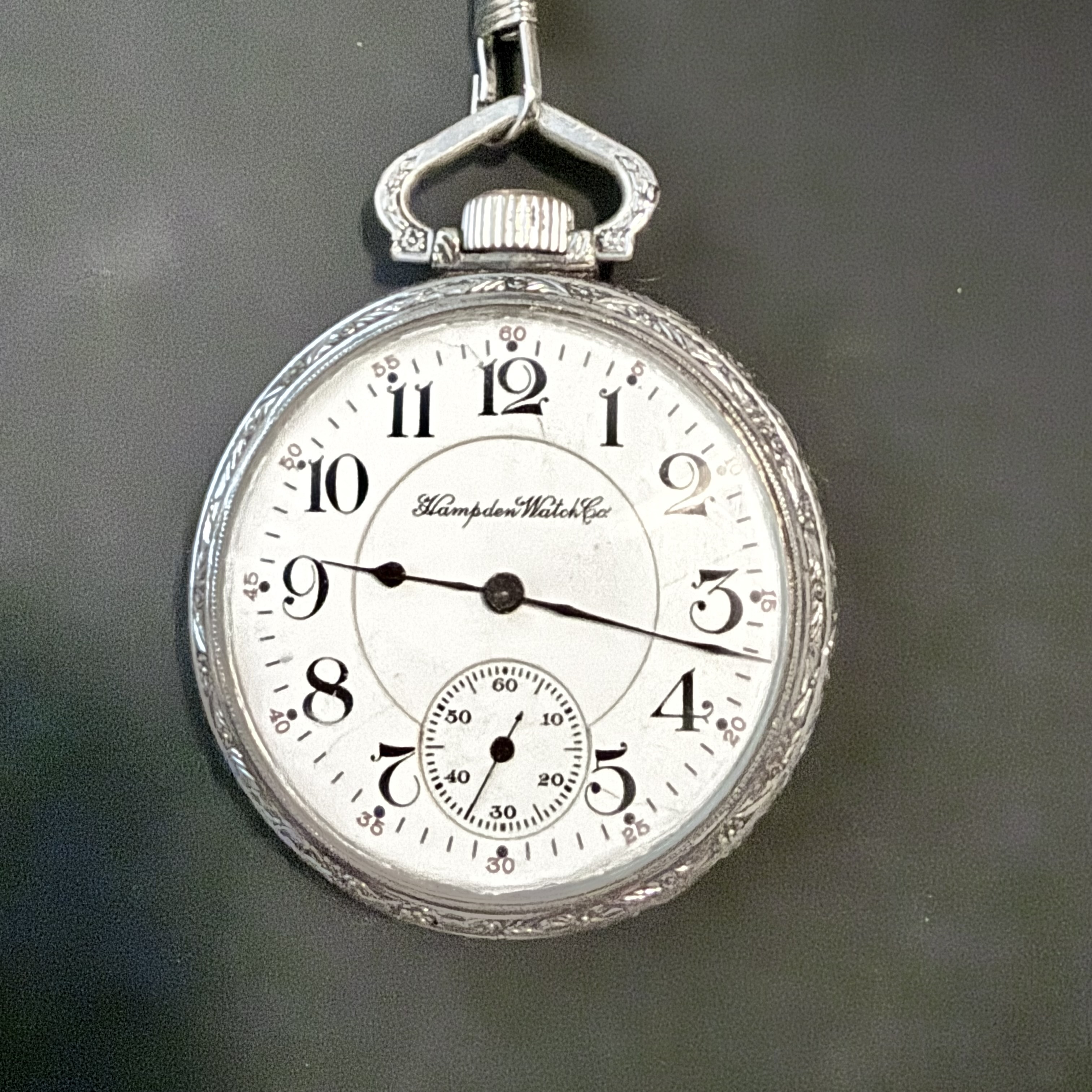
A pocket watch listing can look convincing with one sharp photograph of the dial. That is not enough information to buy confidently. The name on the dial may be useful, but the movement, case, condition, and evidence of past work are often more important.
Before you make an offer, ask the seller for these five photographs. A good seller should be able to provide most of them. If they cannot, treat the missing view as uncertainty, not a detail to assume in your favor.
1. A straight, close photograph of the dial and hands
Ask for a photograph taken square to the dial, in even light, with the hands clearly visible. It should show the entire dial, minute track, signature, seconds register, and the condition of the hands.
Look for hairlines, chips around the winding arbor, stains, uneven printing, missing luminous material, and hands that do not match the apparent age or style of the watch. A perfect looking dial is not automatically original. A damaged dial is not automatically a deal breaker. The question is whether the listing acknowledges what is actually there.
2. A clear movement photograph, with the dust cover opened if the watch has one
The movement is the identity card of a pocket watch. Ask for a direct, well lit photograph with the case back open. If there is an inner dust cover, ask for a photograph with that cover opened too, provided it can be done without forcing it.
You are looking for the maker name, serial number, jewel count where marked, grade or model markings, regulator, and general condition. A movement photograph can also reveal rust, damaged screws, obvious missing parts, heavy tool marks, or a mismatch between the movement and the claims in the listing.

.jpg)
Do not ask an inexperienced seller to pry open a stubborn cover. A broken hinge, bent lip, or damaged dust cover is worse than an unanswered question. If the movement cannot be photographed safely, price the watch as an unverified example.
3. The inside of the case back, including every stamp and number
The case and movement have separate stories. Ask for the inside of the outer case back and, where present, the inside of the inner back or dust cover. The photographs should be close enough to read hallmarks, metal marks, serial numbers, and maker marks.
These markings can help establish case material, assay information, country of origin, and whether a case number is present. They do not by themselves prove that the movement and case left the factory together. They are evidence to compare, not a shortcut to certainty.

.jpg)
A case can be plated, filled, base metal, or a later replacement. Likewise, a movement serial number is useful only after it has been checked against an appropriate manufacturer or reference source.
4. A side view showing the crown, bow, pendant, and case thickness
Ask for a side profile of the watch, with special attention to the crown, bow, pendant, hinge area, and the gap between covers. This is one of the most useful photographs for detecting trouble that a front view hides.
Look for a crown that sits crooked, a loose or worn bow, a pendant that appears repaired, covers that do not close evenly, or obvious dents around the case edge. None of these conditions make a watch worthless. They do affect service needs, durability, and value.
5. Evidence that it runs, or an honest photograph of the problem
For a running watch, ask for a short video showing it being wound and running for a few seconds, plus a photograph of the hands set to a recognizable time. This does not prove timekeeping accuracy or recent service. It does establish more than a claim that it “runs.”
For a nonrunning watch, ask for a clear photograph of the movement and a plain description of what happens when the crown is turned. Does it wind but not start? Does the crown turn without resistance? Is the balance visibly damaged? Honest uncertainty is more useful than optimistic language.
Do not ask a seller to force the crown, repeatedly wind an already tight mainspring, or open a case with improvised tools. A simple request for a video or an existing condition photograph is enough to improve your decision.
Put the five photographs together
- The dial tells you what is visible from the front.
- The movement provides the most useful identification evidence.
- The case marks help establish the case itself.
- The side view exposes structural wear and repair clues.
- A running demonstration separates a working claim from a verified observation.
If a listing offers only a dial photograph and a broad claim such as “working,” you do not have enough information to estimate condition or repair risk confidently. Walk away, ask for more photographs, or make an offer that reflects the uncertainty.
A final collector’s note
The goal is not to eliminate every risk. Vintage pocket watches have lived long, complicated lives. The goal is to know which questions remain unanswered before you spend money.
A watch with honest wear, a clear movement photograph, readable case marks, and a seller who answers straightforward questions can be far more compelling than a glossy listing with little evidence. Buy the watch in front of you, not the story supplied by a single photograph.
Image credits
- Lead photograph: Balance of Time, user supplied Hampden pocket watch photograph.
- Waltham movement reference: Auckland Museum Tāmaki Paenga Hira, CC BY 4.0, via Wikimedia Commons.
- Swiss lever pocket watch reference: Auckland Museum Tāmaki Paenga Hira, CC BY 2.0, via Wikimedia Commons.